Raspberry Pi 500+, a daily driver?
What if you wanted to stop buying US Big Tech? You'd probably have a hard time finding other alternatives to US products. Some countries are increasingly planning for a world where the US decides to cut off digital services from the global economy in some way. People are beginning to ask the question; if they did it, how quickly could we get back up and running without Microsoft, Apple, Google, and the rest -- and would it make more sense to switch entirely?
Thing is, we have all our software infrastructure more-or-less centralised at American data centres. This situation suits the major players and their mostly-satisfied users, but it's less good for power users who are used to tinkering with their computers as a freetime activity. We've been in that situation for a while now.
The good news: power users are still well-catered for in the software world. I now use Office NX from German software house Softmaker for productivity, rather than Office 365. Spotify commits all sorts of sins but they are nonetheless a Swedish company; I don't see a need to change there, except maybe to buy more CDs from Bandcamp. You can replace Gmail with Proton Mail hailing from Switzerland; chatbot and VPN services available too. Google Search can be substituted with UK-based Mojeek or German-based GOOD Search.
However, finding non-US hardware remains a persistent nuisance. I came to the realisation early on: there's just not much out there to replace what you likely have to hand already. This is only half-true with things like smartphones; that's a very lively category with lots of choice from many different countries. Laptops and home computers, though... Much more difficult to replace something like that.
Oooh, but guck mal!
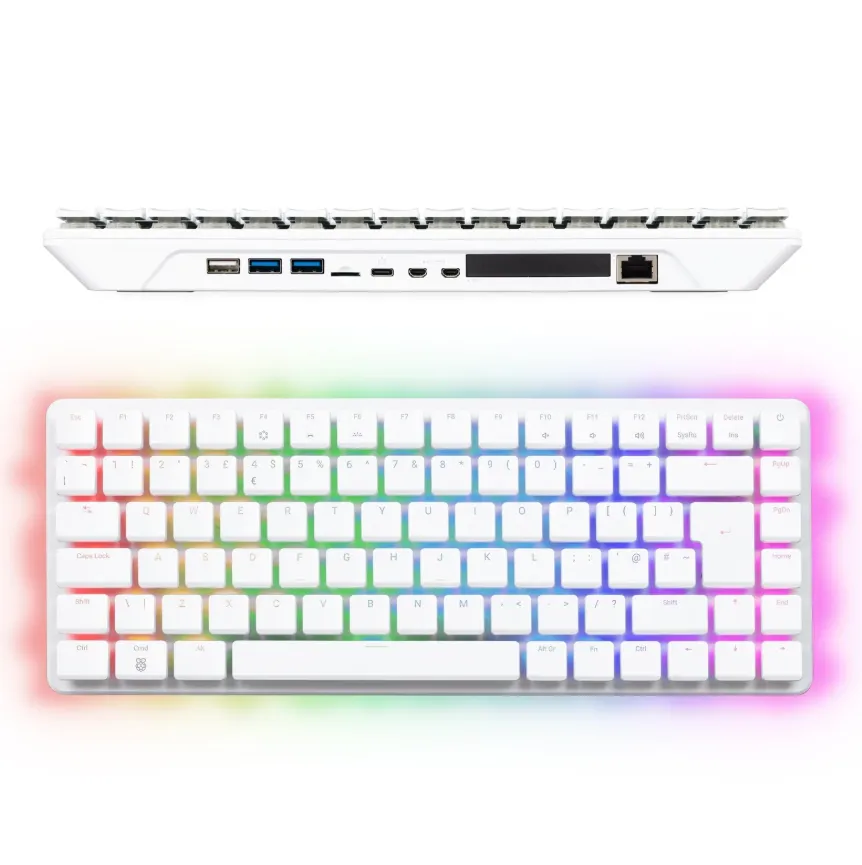
This is the Raspberry Pi 500+: an all-in-one keyboard computer like a modern day Amiga. SBCs are still best-suited to small projects and IoT applications, but I think there's an emerging case for the Pi as a platform distinct from X86 and Apple Silicon for those who seek to support the European tech industry. For those people, the 500+ offers ultra-low power consumption, 16GB of RAM, and 256GB of SSD storage for under £400.
That's a very high price for a Raspberry Pi, but with the price increases on tech products this year showing no sign of slowing down -- in this category and at this price point it's a "top-spec hot-hatch vs. base model sports coupe" comparison. I'd say the 500+ could be a cheap and cheerful PC for someone who needs lots of RAM and storage but doesn't need a high-end GPU. I don't tend to play many computer games, so this could be me.
This is the best professional review I've found of the 500+, and I think it's sensible to read as many reviews as possible about this device first. Software support is a significant real-world advantage for Raspberry Pi over competing platforms, and this tends to comes up in every review for the 500+. Many of your daily tasks can be done on the Raspberry Pi using software that's included as standard -- if you are happy using Big Tech's cloud services, you can probably use them on this through a browser.
2026 has seen some interesting things happening around the all-in-one category in general. See the Caligra C100 for another UK-made all-in-one. It costs significantly more than the 500+, but it's also higher-specced than the 500+. $1400 for 32GB RAM and 512GB SSD in the most gorgeous case you've ever seen. I think that price will go up by the time the first C100 units are ready to be delivered. As well, the 500+ will probably see another price increase in 2027 as that AI-related memory shortage starts to bite.
Given a moment of weakness, I will probably buy this thing and find out for myself how it is to use as a full-time home computer. It could either be a pain in the arse, a little bit like the Gemini PDA, or it could be a whole new product category for Raspberry Pi that will only get better with time.